
What do wheel loader tyres have to withstand at work?
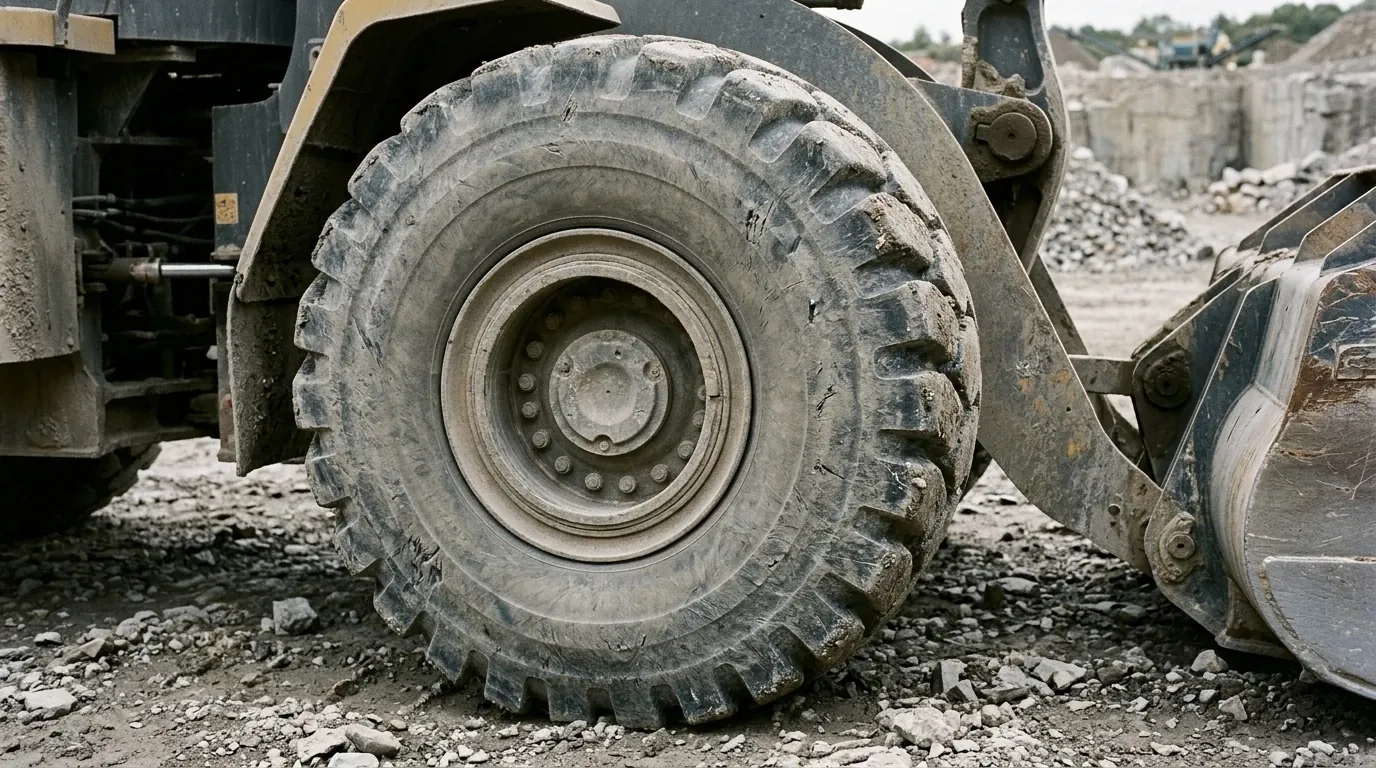
A wheel loader scoops material, drives a short distance, turns and dumps. On a quarry floor, in a mine or on a construction site, the tyres are constantly cut by rock edges, punctured by sharp objects and loaded unevenly each time the bucket lifts. That is why wheel loader tyres belong to the group of OTR off-the-road tyres and are designed very differently from road truck tyres.
Short answer: choose the size to match the vehicle's original tyre size (usually from 17.5-25 to 26.5-25), choose the tread code to match the working surface (E-3/L-3 is the common deep tread, L-5 is the extra-deep tread for rock), then choose radial or bias according to the travel distance and the risk of cuts and punctures.
Common wheel loader tyre sizes
The four sizes most often seen are 17.5-25, 20.5-25, 23.5-25 and 26.5-25. The first number is the section width in inches, and the second number (25) is the rim diameter. You can view each specification page separately: 17.5-25, 20.5-25 and 23.5-25. The detailed way to read the markings is in the article reading tyre specifications.
| Size | PR | Tread pattern | Tread depth | Max load | Pressure | Speed |
|---|---|---|---|---|---|---|
| 17.5-25 | 20PR | L-3K | 25.5 mm | 4,750 kg | 575 kPa (83 PSI) | B (50 km/h) |
| 20.5-25 | 20PR | L-3K | 30.0 mm | 5,550 kg | 575 kPa (83 PSI) | B (50 km/h) |
| 20.5-25 | 24PR | E-3/L-3 | 34.5 mm | 5,550 kg | 575 kPa (83 PSI) | B (50 km/h) |
| 23.5-25 | 20PR | L-5K | 78.5 mm | 6,400 kg | 575 kPa (83 PSI) | A2 (10 km/h) |
| 23.5-25 | 24PR | E-3/L-3 | 38.0 mm | 6,400 kg | 575 kPa (83 PSI) | B (50 km/h) |
| 26.5-25 | 28PR | E-3/L-3 | 38.0 mm | 7,200 kg | 575 kPa (83 PSI) | A8 (40 km/h) |
What do the tread codes E-3, L-3 and L-5 mean?
The TRA code indicates the application group and the tread depth. According to the catalogue notes:
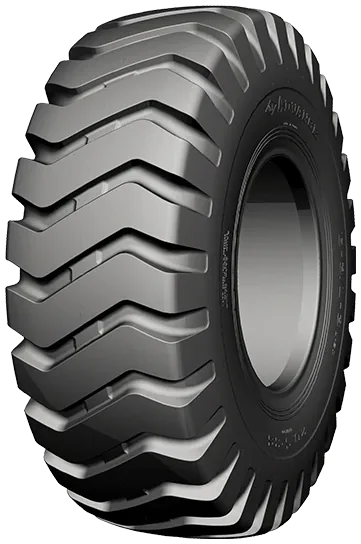
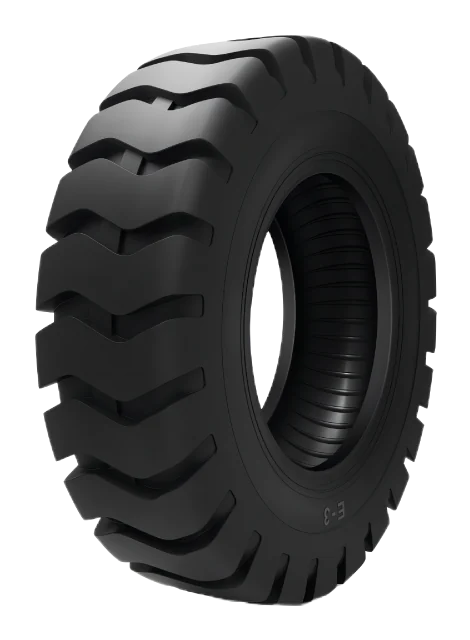
- E-3/L-3: used for wheel loaders and bulldozers, deep tread. This is the common code for construction sites with mixed soil and rock.
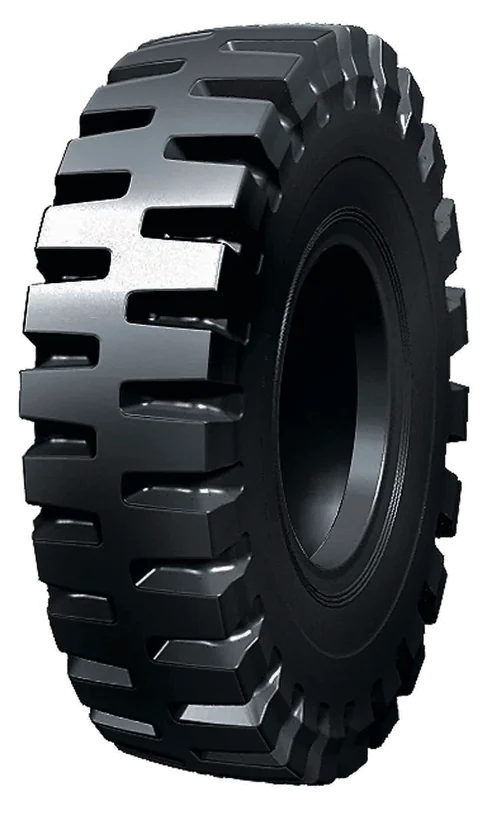
- L-5: extra-deep tread for rock. In the table above, the 23.5-25 tyre with code L-5K has a 78.5 mm tread, much deeper than the other codes.
- L-3K: a variant of the L-3 code (marked K), appearing in sizes 17.5-25 and 20.5-25 at 20PR, with a tread of 25.5 mm and 30.0 mm. Ask technical support what the letter K means when needed.
Deep tread or standard tread: how to choose?
The deeper the tread, the more rubber there is to wear and to resist cuts, but the tyre heats up more easily on long runs. For sharp rock surfaces and quarries, prefer a deep tread such as L-5 or E-3/L-3. On soil, sand or surfaces with little rock, a shallower tread can be used. Note that the L-5K tyre in the table has speed rating A2 (10 km/h): it suits very short runs within the mine and is not suitable for travelling long distances.
Radial or bias for wheel loaders?
Bias (cross-ply) has stiffer sidewalls and is the familiar configuration on construction sites. Radial has a stable contact patch, but the sidewall needs to be protected from cuts. The ADVANCE catalogue has both types for wheel loaders.
| Size | Tread pattern | Star rating / LI | Tread depth | Max load | Pressure | Speed |
|---|---|---|---|---|---|---|
| 445/80R25 | GLB05 | 2 sao / 170F | 25.0 mm | 6,000 kg | 900 kPa (130 PSI) | F (80 km/h) |
| 445/95R25 | GLB05 | 2 sao / 174F | 25.0 mm | 6,700 kg | 900 kPa (130 PSI) | F (80 km/h) |
| 525/80R25 | GLB05 | 2 sao / 176F | 31.0 mm | 7,750 kg | 700 kPa (102 PSI) | F (80 km/h) |
The catalogue also lists radial sizes 17.5R25, 20.5R25 and 23.5R25 (tread patterns GLR02, GLR09, tread 38.0 mm, speed rating B). For these sizes the maximum load and pressure have not been verified, so ask technical support when you need the figures.
Cuts and punctures: causes and how to reduce them
- Clear the work area: sharp rock and scattered steel are common causes. Clearing the travel path noticeably reduces damage.
- Do not charge into piles of sharp rock at speed: cuts usually appear on the shoulder and sidewall of the tyre.
- Use the right tread code: a tread that is too shallow for rock surfaces will be cut faster.
- Check at the end of each shift: look for deep cuts, exposed plies and sharp objects lodged in the tread.
Pressure and load
The rated pressure of the bias tyres in the first table is 575 kPa (83 PSI). Underinflation makes the sidewall fold, heat up and crack easily; overinflation makes the tyre stiff and easy to cut. Measure when the tyre is cold and compare against the load table for the specification. For general principles, see the article tyre pressure and the technical specifications page.
When should wheel loader tyres be replaced?
- The tread is nearly worn out or clearly worn unevenly.
- A deep cut reaches the ply layer, or the sidewall bulges or cracks.
- The tyre has been run underinflated several times.
- Working conditions have changed and the configuration needs to change (bias to radial, or to a deeper tread).
When choosing replacement tyres, see the OTR off-the-road tyres group. If the site also uses forklifts, see also forklift tyres.
Send a quotation request
The website only presents products and receives requests; it does not sell online. Send your current tyre size, vehicle type, working surface and quantity through the contact page to get advice on the specification and a quotation.
Frequently asked questions
- What tread patterns does a 23.5-25 wheel loader tyre come in?
- The ADVANCE catalogue has the bias L-5K (tread 78.5 mm, for rock) and the bias E-3/L-3 (tread 38.0 mm), along with 23.5R25 radials.
- How does E-3/L-3 differ from L-5?
- E-3/L-3 is a deep tread for wheel loaders and bulldozers. L-5 is an extra-deep tread for rock.
- How much pressure should wheel loader tyres have?
- The bias tyres in the table are at 575 kPa (83 PSI). Radial 445/80R25 and 445/95R25 are at 900 kPa, and 525/80R25 is at 700 kPa. Measure when the tyre is cold.
- Is radial or bias more durable?
- There is no general answer. It depends on the working surface, the travel distance and the risk of sidewall cuts. Send your conditions of use to get advice.
- How do I find out the size of the wheel loader tyre I am using?
- Read the marking on the sidewall, for example 20.5-25, then compare it with the matching specification page.
Need a tyre quotation?
Send your sizes and quantities and our sales team replies with a project quotation within 24 working hours.
Sizes that match this guide
Add them straight to the quotation request and send once.