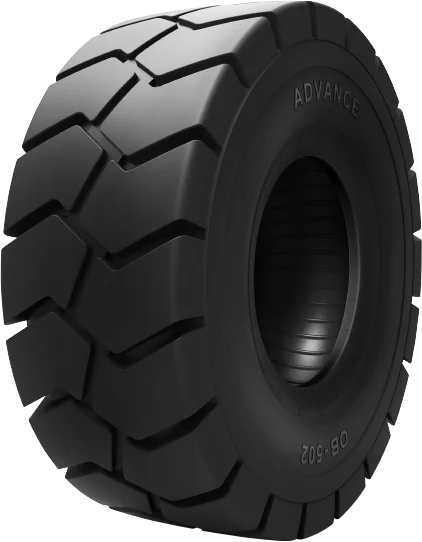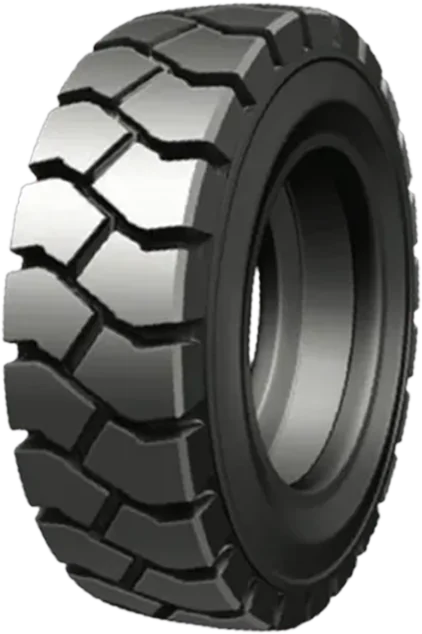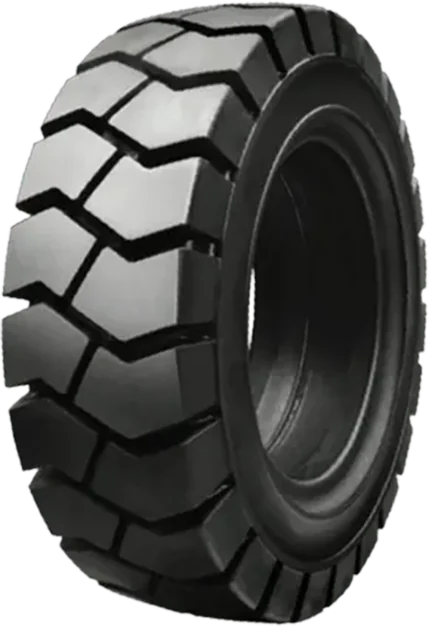

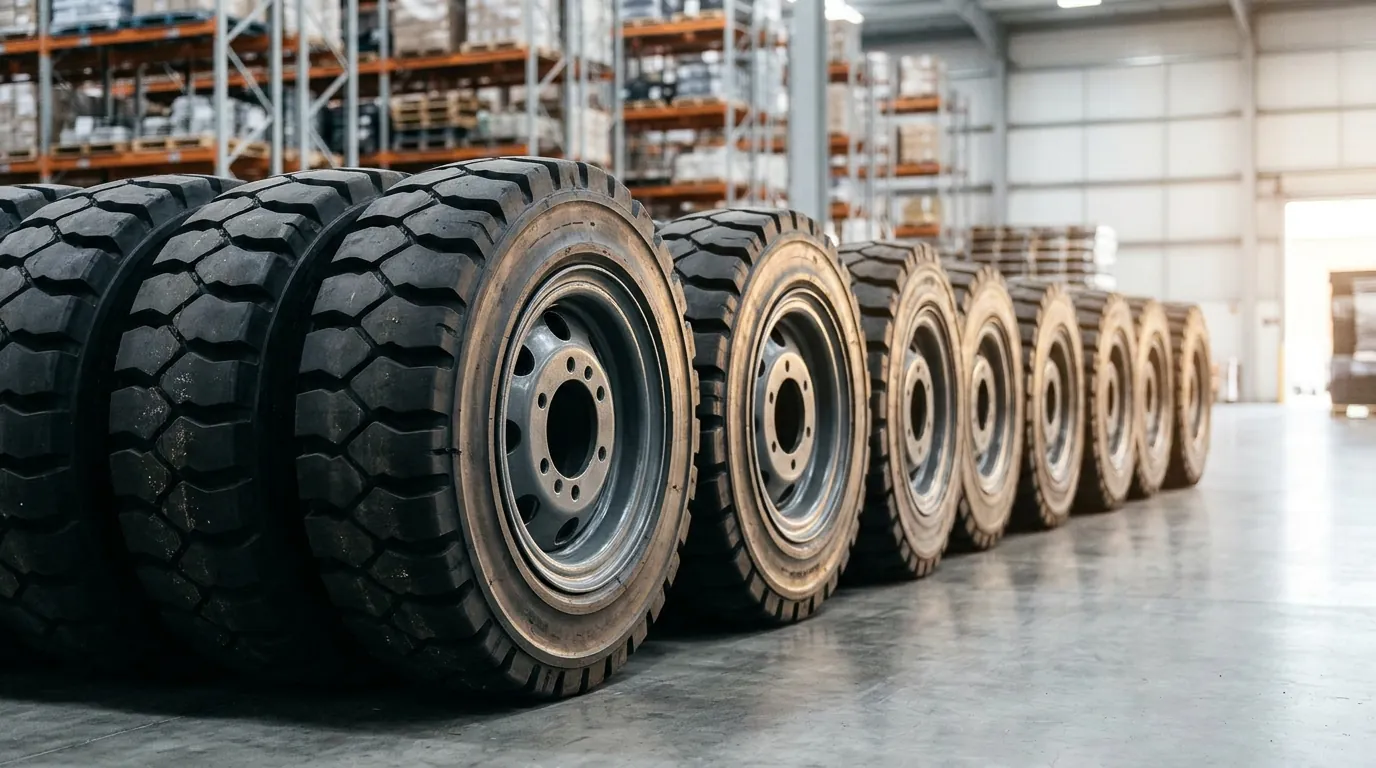
Three types of forklift tyre
Forklift tyres fall into three main groups by construction: solid, pneumatic and soft solid. Each suits a different working environment, and choosing the wrong group is the most common cause of premature tyre failure.
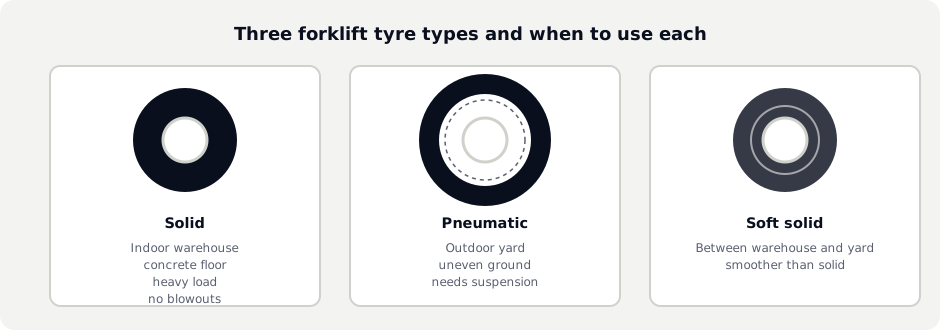
| Criteria | Solid tyre | Pneumatic tyre | Soft solid tyre |
|---|---|---|---|
| Puncture resistance | Absolute, no compressed air | Can puncture or be pierced | Absolute |
| Ride comfort | Poorest, transmits vibration | Smoothest, good shock absorption | Moderate, smoother than a solid tyre |
| Suitable floor surface | Concrete, flat indoor floors | Yard surfaces, uneven terrain | Both indoors and outdoors |
| Overall vehicle height | Lower | Higher than solid tyres | Lower than pneumatic tyres |
| Service life in a closed warehouse | Very high | Average | Cao |
Short answer: a closed warehouse with a concrete floor calls for solid tyres; outdoor yards or uneven terrain call for pneumatic tyres; where both conditions apply, choose soft solid tyres.
Selecting forklift tyres by lift capacity and lift height
Maximum lift capacity and lift height determine tyre size and ply rating. At high lift heights the centre of gravity shifts upwards and the front tyres carry far more load than the rated capacity. Always check the forklift manufacturer's load chart rather than relying only on the figure on the nameplate.
- Lift capacity under 2 tonnes: small size group 5.00-8, 6.00-9, 6.50-10.
- Lift capacity 2 – 3.5 tonnes: size group 7.00-12, 8.25-15, 28x9-15.
- Lift capacity above 3.5 tonnes: size group 9.00-20, 300-15, 21x8-9.
- High lift heights: a tyre with a smaller outside diameter is needed to keep the overall height down, and warehouse ceiling clearance must also be checked.
Common forklift tyre sizes in the range
The range currently covers 25 forklift and industrial tyre specifications, from the small 5.00-8 up to 28x9-15, in both solid and pneumatic versions.
| Rim | Sizes in the catalogue | Typical vehicles |
|---|---|---|
| Rims 15–16 inch | 6.50R16, 7.00R15, 7.00R16, 7.50R16, 8.25R16 | Light trucks and small coaches |
| Rims 17.5–19.5 inch | 9.5R17.5, 215/75R17.5, 245/70R17.5, 245/70R19.5, 265/70R19.5, 285/70R19.5 | Medium trucks and buses |
| Rims 20–21 inch | 8.25R20, 9.00R20, 10.00R20, 11.00R20, 12.00R20, 14.00R20, 16.00R20, 365/80R20, 365/85R20, 425/85R21 | Heavy trucks and long-distance coaches |
| Rims 22.5–24 inch | 9R22.5, 10R22.5, 11R22.5, 12.00R24, 12R22.5, 255/70R22.5, 275/70R22.5, 275/80R22.5, 295/60R22.5, 295/75R22.5, 295/80R22.5, 315/80R22.5, 325/95R24, 385/65R22.5, 425/65R22.5, 445/65R22.5 | Tractor units, heavy trucks and trailers |
Checks before ordering forklift tyres
- Correct size and rim: note the size on the sidewall of the old tyre, including the part after the slash (for example 28x9-15/7.00).
- Correct tyre type: solid and pneumatic tyres are not interchangeable because they use different rims and differ in height.
- Correct load: check the maximum lift capacity and lift height against the truck's load chart.
- Correct floor conditions: oil on the floor, metal debris or speed bumps all affect tyre life.
- Check the rim: a rusty or deformed rim causes bead cracking in solid tyres and air leaks in pneumatic tyres.
Forklift tyre maintenance
- Clean tyres and rims at regular intervals; do not let oil or chemicals remain on the rubber for long periods.
- Check for bead cracks and sidewall cuts every month.
- For pneumatic tyres, check inflation pressure weekly; for solid tyres, check tread wear and cracking.
- Do not drag a heavy load with the truck stationary — this is the leading cause of localised wear on solid tyres.
Frequently asked questions
- Can solid and pneumatic tyres be interchanged?
- No. The two types use different rims and differ in height; interchanging them compromises safety.
- How often do forklift tyres need replacing?
- There is no fixed interval. Replace when the tread wears to the limit mark, when the tyre shows bead or sidewall cracking, or when a pneumatic tyre bulges.
- Which tyre should be chosen for a forklift working both indoors and outdoors?
- Soft solid tyres are the compromise option: they cannot go flat, as with any solid tyre, yet ride more comfortably outdoors.
- Do solid tyres need inflating?
- No. A solid tyre is a one-piece moulded rubber block and uses no compressed air.
Need a tyre quotation?
Send your sizes and quantities and our sales team replies with a project quotation within 24 working hours.
Sizes that match this guide
Add them straight to the quotation request and send once.