

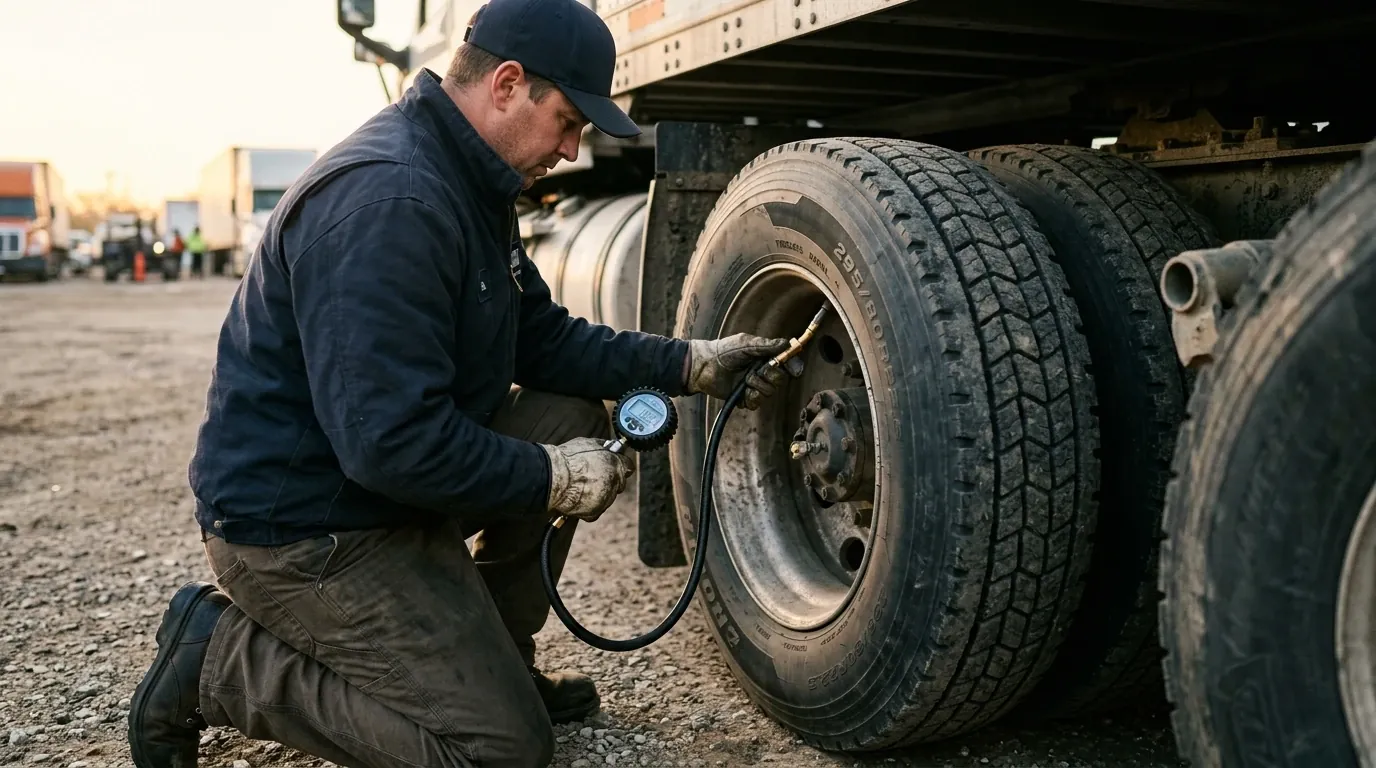
Where do I find the recommended pressure?
- The tyre manufacturer's load and pressure table: shows the maximum load for each size at each pressure level.
- Vehicle manufacturer's recommendation: pressure based on the actual load on each axle.
- Sidewall: shows the maximum pressure; do not inflate above this value.
What do under-inflation and over-inflation cause?
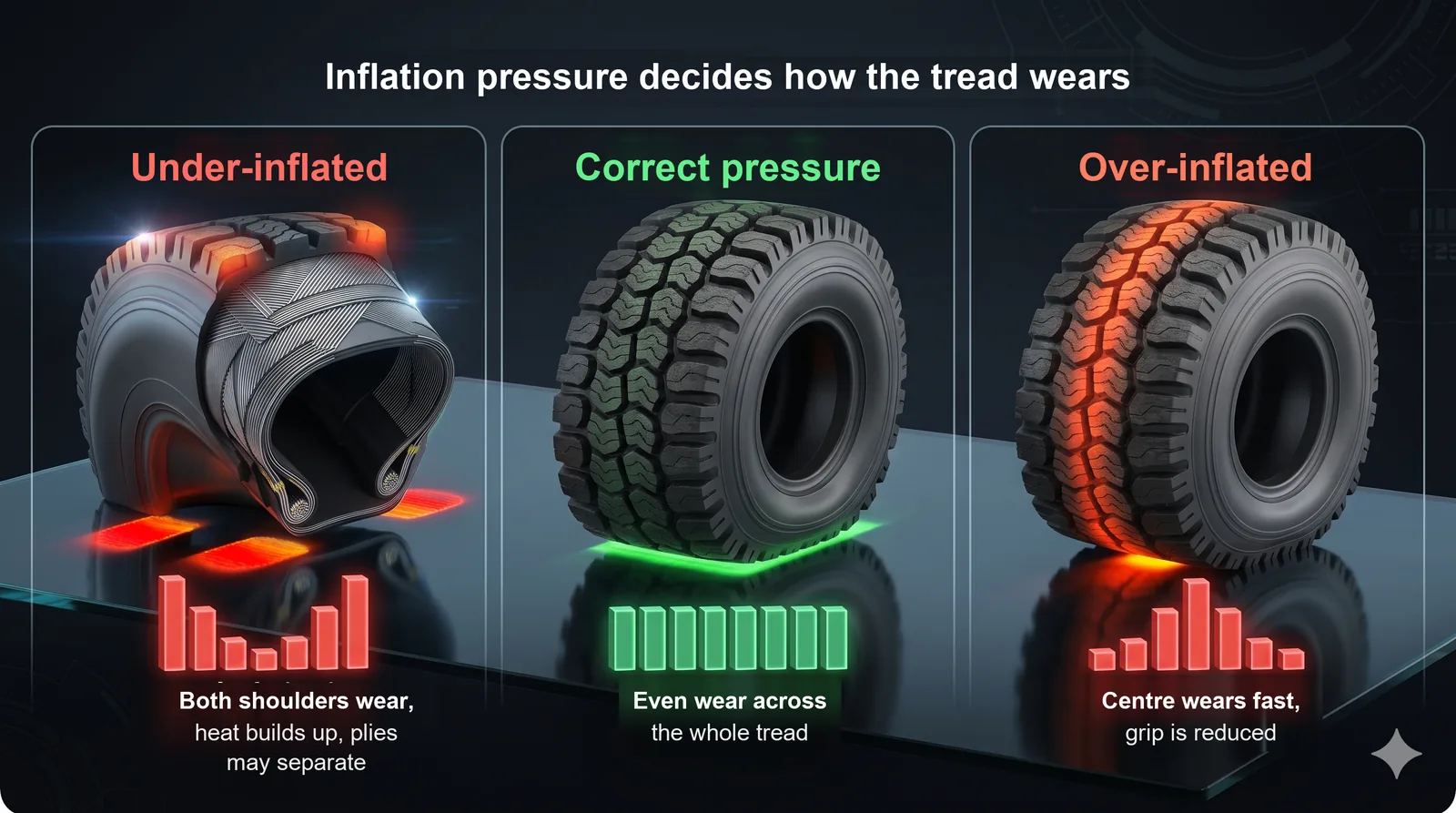
| Condition | Symptoms | Consequences |
|---|---|---|
| Under-inflation | Shoulders wear, sidewall flexes and bends, heat builds up quickly | Casing ply separation, blowouts under heavy loads, higher fuel consumption, shorter service life |
| Over-inflation | Centre of the tread wears quickly and the contact patch shrinks | Reduced grip, easier skidding, more likely to blow out on sharp objects; rim and suspension take more shock |
| Correct pressure | Even wear across the whole tread, stable temperature | Low rolling resistance and fuel savings; regrooving and retreading are easier when the technical team confirms they apply |
Reference pressures by tyre size in the catalogue
The table below is taken from specifications checked against the Guizhou Tyre catalogue and gives the pressure at maximum load for each size. These are reference values only: the actual pressure must follow the vehicle load and the manufacturer's instructions.
| Tyre size | Ply rating (PR) | Pressure at max load | Max load (kg, single / dual) |
|---|---|---|---|
| 7.50R16 | 14PR | 770 kPa (112 PSI) | 1,800 / 1,600 kg |
| 10.00R20 | 18PR | 830 kPa (120 PSI) | 3,250 / 3,000 kg |
| 11.00R20 | 16PR | 830 kPa (120 PSI) | 3,350 / 3,075 kg |
| 11.00R20 | 18PR | 930 kPa (135 PSI) | 3,550 / 3,250 kg |
| 12.00R20 | 20PR | 900 kPa (131 PSI) | 4,000 / 3,650 kg |
| 315/80R22.5 | 18PR | 830 kPa (120 PSI) | 3,750 / 3,450 kg |
| 315/80R22.5 | 22PR | 900 kPa (131 PSI) | 4,250 / 4,000 kg |
| 385/65R22.5 | 20PR | 900 kPa (131 PSI) | 4,500 kg |
| 385/65R22.5 | 24PR | 900 kPa (131 PSI) | 5,000 kg |
Pressure unit conversion
Tyre specifications are usually given in kPa and psi, while inflation gauges may show bar. 100 kPa equals 1 bar and about 14.5 psi.
| kPa | bar | psi |
|---|---|---|
| 700 | 7.0 | 101.5 |
| 800 | 8.0 | 116.0 |
| 830 | 8.3 | 120.4 |
| 900 | 9.0 | 130.5 |
| 930 | 9.3 | 134.9 |
Checking pressure: when and how?
- Measure when the tyres are cold, i.e. before driving or after the vehicle has been parked long enough.
- Check every tyre, including the spare, before each trip; also check for cuts, cracks, bulges or punctures.
- Keep the pressure difference between wheels on the same axle small.
- Dual-fitted tyres need the same pressure so that the two tyres share the load evenly.
According to Guizhou Tyre's guidance, if abnormal wear persists after mechanical faults have been corrected: for steer-axle tyres, check wheel alignment and raise the pressure within the permitted limit (100–115 psi); for drive-axle tyres, adding 10–15 psi helps reduce abnormal wear. These psi values come from the guidance for abnormal wear and do not replace the load and pressure table of each size. For details see the technical handbook and how to read tread wear.
Frequently asked questions
- What is the tyre pressure for a truck?
- There is no single figure: pressure depends on the tyre size and the actual load. For many heavy-duty sizes, the pressure at maximum load is in the range 800–930 kPa (about 116–135 psi); always use the load table for the exact size.
- Should truck tyres be inflated when hot or cold?
- When cold. A tyre that has been running is hotter and its pressure reads higher, so measuring then is not accurate.
- What should I know about the air used to inflate tyres?
- What matters is that the compressed air is dry and free of moisture, because moisture inside a steel-belted radial tyre can rust the steel cords. Guizhou Tyre's guidance stresses keeping the compressed air used for inflating tyres dry.
- How often should pressure be checked?
- Check before every trip and regularly during use, measuring when the tyres are cold.
Need a tyre quotation?
Send your sizes and quantities and our sales team replies with a project quotation within 24 working hours.
See also
 TBR
What is a TBR tyre?
Structure, classification, tread codes and how to choose a radial truck tyre.
Read the guide → OTR
What is an OTR tyre?
Construction and mining tyres, radial or bias, and how to choose by machine.
Read the guide → SIZE
How to read truck tyre markings
Explains 11.00R20 18PR 152/149K: rim, ply rating, load index, speed.
Read the guide →