

Inch-series tyre sizes: e.g. 11.00R20
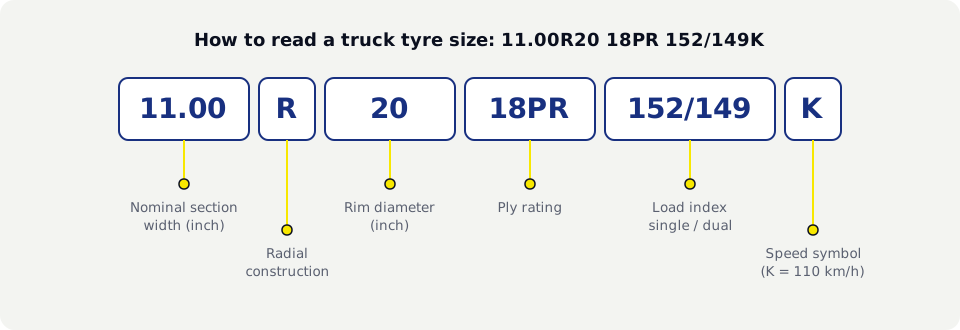
- 11.00: nominal tyre width, in inches.
- R: radial construction. Bias tyres use a hyphen, e.g. 10.00-20.
- 20: rim diameter, in inches.
- 18PR: ply rating (PR), see the section below.
Metric tyre sizes: e.g. 315/80R22.5
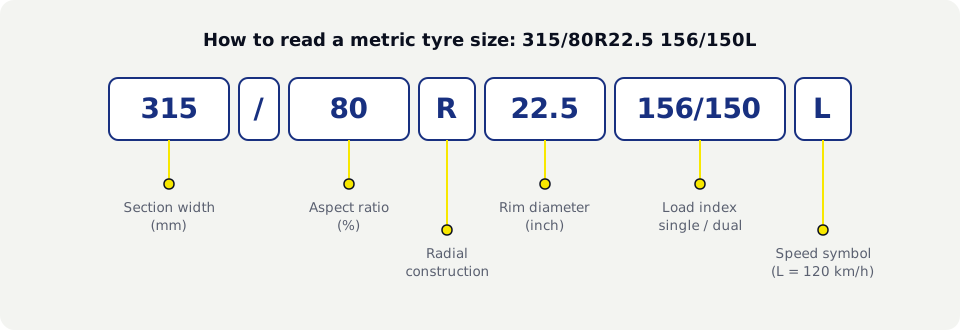
- 315: section width of the tyre, in mm.
- 80: aspect ratio, the sidewall height as a percentage of the width.
- R: radial construction.
- 22.5: rim diameter, in inches.
What does ply rating (PR) mean?
PR (Ply Rating) is the conventional strength rating of a tyre, equivalent to the number of cotton ply layers needed to reach that strength under traditional calculation. For modern radial tyres, PR is not the actual number of plies but a load rating. The higher the PR, the greater the load and pressure the tyre can carry: for example, 18PR is for heavy-duty tyres and 12PR for light truck tyres.
Load index (LI): single and dual fitment
The load index is a code that converts to the maximum load one tyre can carry. Truck tyres usually have two indices: the first is used for single fitment (one tyre at each axle end), and the second for dual fitment (two tyres paired, each carrying slightly less). The table below converts common load indices to kg.
| Load index (LI) | Max load per tyre (kg) | Load index (LI) | Max load per tyre (kg) |
|---|---|---|---|
| 120 | 1,400 | 142 | 2,650 |
| 122 | 1,500 | 144 | 2,800 |
| 124 | 1,600 | 146 | 3,000 |
| 126 | 1,700 | 148 | 3,150 |
| 128 | 1,800 | 149 | 3,250 |
| 130 | 1,900 | 150 | 3,350 |
| 132 | 2,000 | 152 | 3,550 |
| 134 | 2,120 | 154 | 3,750 |
| 136 | 2,240 | 156 | 4,000 |
| 138 | 2,360 | 160 | 4,500 |
| 140 | 2,500 | 164 | 5,000 |
How to use: divide the load on each axle by the number of tyres on that axle to get the load per tyre, then choose a tyre whose load index is equal to or greater than that value, preferably with a safety margin. The tyre selection tool performs this calculation for you.
Speed symbol
| Symbol | Maximum speed |
|---|---|
| F | 80 km/h |
| G | 90 km/h |
| J | 100 km/h |
| K | 110 km/h |
| L | 120 km/h |
| M | 130 km/h |
TTF, TL in product names
- TL (Tubeless): tubeless tyre, fitted directly onto an airtight rim.
- TTF (Tube Type + Flap): tyre set that includes an inner tube and rim flap.
Frequently asked questions
- Is PR the actual number of plies?
- Not exactly. PR is a conventional strength rating and does not necessarily equal the actual number of plies in a modern radial tyre.
- What does load index 152/149 mean?
- These are two indices: 152 for single fitment and 149 for dual fitment. According to the international conversion table, 152 corresponds to 3,550 kg per tyre and 149 to 3,250 kg per tyre.
- Can I choose a tyre with a lower load index than the vehicle recommends?
- No. The tyre must have a load index equal to or greater than the value the vehicle requires, to avoid overloading.
- Can I switch from 11.00R20 to 295/80R22.5?
- These two sizes have different rim diameters (20 inch and 22.5 inch), so both rims must be changed and the vehicle's specifications rechecked. Please contact the technical team for advice.
Need a tyre quotation?
Send your sizes and quantities and our sales team replies with a project quotation within 24 working hours.
See also
 TBR
What is a TBR tyre?
Structure, classification, tread codes and how to choose a radial truck tyre.
Read the guide → OTR
What is an OTR tyre?
Construction and mining tyres, radial or bias, and how to choose by machine.
Read the guide → PSI
Truck tyre pressure
The right pressure, how to check it, and a reference pressure table.
Read the guide →