
Why shouldn't tyres be compared on purchase price alone?
For a fleet running 100,000 km a year, a difference of a few hundred thousand dong per tyre is small against a difference of tens of thousands of kilometres in service life. Cost per kilometre gives a fair comparison between options.
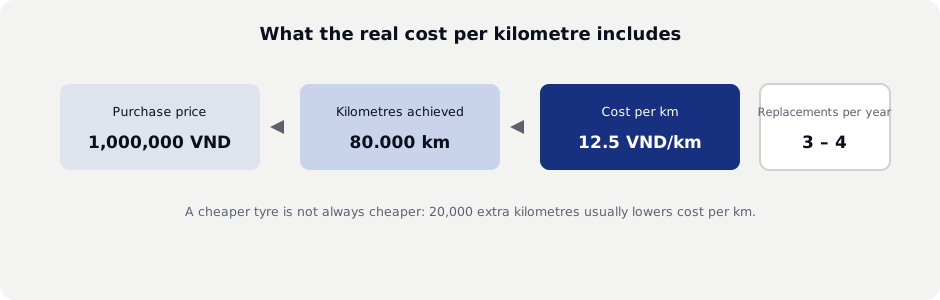
Short answer: cost per km = tyre purchase price ÷ kilometres the tyre runs. Add the cost of fitting, balancing and vehicle downtime.
Formula for tyre cost per kilometre
Simple formula: divide the purchase price of one tyre by the kilometres it runs before replacement. For example, a tyre costing 3,500,000 dong that runs 120,000 km costs about 29 dong per km per tyre. For a 10-wheel vehicle, multiply accordingly.
| Criterion | Option A | Option B |
|---|---|---|
| Purchase price per tyre | 3,000,000 VND | 3,800,000 VND |
| Kilometres run | 90,000 km | 130,000 km |
| Cost per km | 33.3 VND | 29.2 VND |
| Replacements per 130,000 km | 1.4 times | 1.0 times |
| Conclusion | Cheap to buy, expensive to run | Expensive to buy, cheap to run |
What determines truck tyre prices?
- Tyre size: 11.00R20 and 12R22.5 differ in price because of rubber volume and construction.
- Ply rating: 18PR usually costs more than 16PR because it has more steel ply layers.
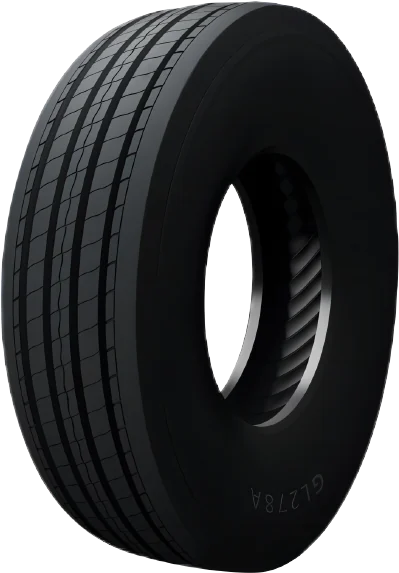
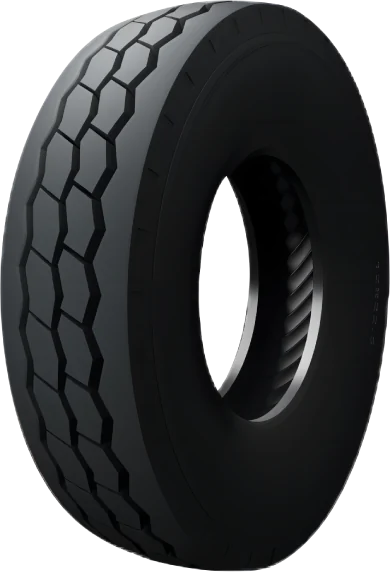
- Tread pattern: patterns dedicated to mining or construction sites cost more than highway patterns.
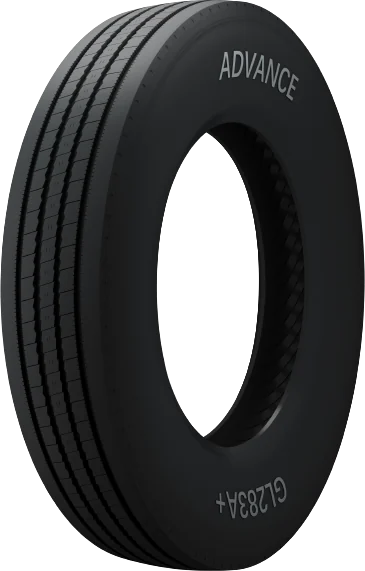
- Brand: SAMSON and ADVANCE both belong to Guizhou Tyre but are positioned differently.
- Order quantity: container-based project orders are priced differently from retail purchases.
- Timing: rubber prices and freight costs fluctuate quarterly.
Factors that raise tyre cost beyond the purchase price
- Incorrect inflation pressure: the leading cause of reduced tyre life. See truck tyre pressure.
- Wrong axle position: fitting a steer pattern on a drive axle makes the tyre slip and wear faster.
- No scheduled tyre rotation: uneven wear between positions.
- Overloading: the tyre overheats, cracks and may burst.
- Poor storage: leaving tyres in the sun or near oil or chemicals ages the rubber.
- Late replacement: running until the tread is worn through damages the casing beyond retreading.
How to cut tyre costs without cutting quality
- Standardise the number of tyre sizes in the fleet to increase order volume and reduce stock.
- Match the tread pattern to each route instead of using one pattern for everything.
- Retread tyres while the casing is still sound — see when to retread a tyre.
- Track kilometres per tyre to catch abnormal wear early.
- Check pressure weekly rather than monthly.
Frequently asked questions
- How much does an 11.00R20 truck tyre cost?
- The price depends on brand, tread pattern, ply rating and quantity. The website does not list prices; send the size and quantity to receive a project quotation.
- Is a more expensive tyre always better?
- Not always. Compare cost per kilometre, not purchase price.
- How do I know which tyre is cheaper per kilometre?
- Divide the purchase price by the kilometres the tyre runs. Actual kilometres depend on load, route and maintenance.
- Should I buy used or retreaded tyres?
- Retreaded tyres can be economical if the casing is sound. Used tyres of unknown origin carry potential safety risks.
Need a tyre quotation?
Send your sizes and quantities and our sales team replies with a project quotation within 24 working hours.
Sizes that match this guide
Add them straight to the quotation request and send once.