
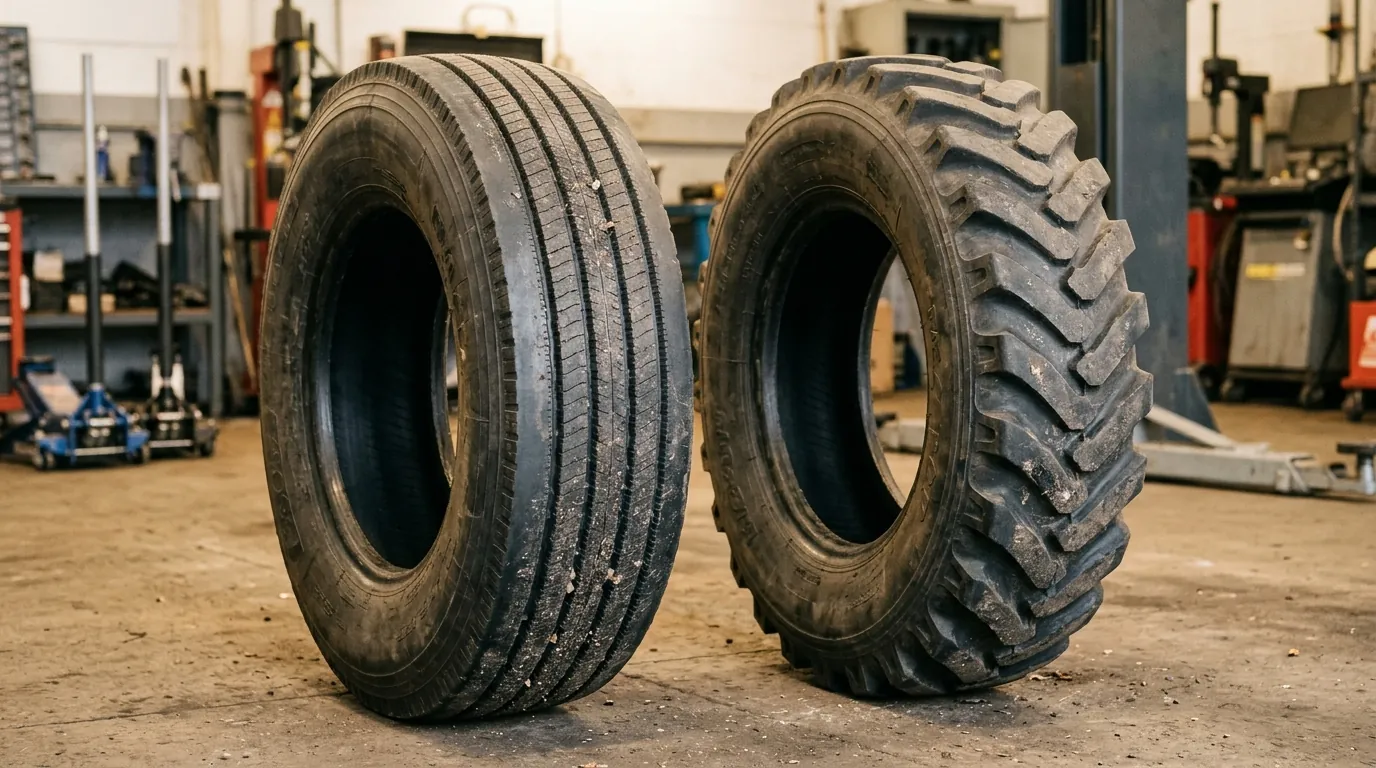
What is tyre retreading?
Retreading is the process of buffing away the worn tread and bonding a new tread onto the casing. The casing is the most expensive part of a tyre, so if it is still sound, retreading is cheaper than buying new. Steel-belted radial tyres can usually be retreaded 1–2 times over their service life.
Short answer: retread when the casing is free of cracks and bulges, the bead is not loose and the tread is above 3 mm. Replace when the casing is deformed, the bead is loose or it has already been retreaded twice.
Conditions for retreading a tyre
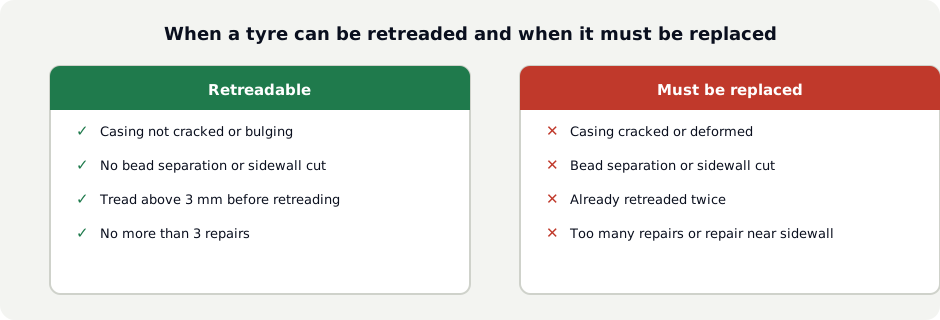
When must a tyre be replaced with a new one?
- Cracked or deformed casing: cannot be restored; a retread will fail immediately.
- Loose bead or torn sidewall: the tyre can no longer hold air and is dangerous in service.
- Already retreaded twice: too little rubber remains for a third retread.
- Too many repairs, or repairs close to the sidewall: weaknesses concentrate and failures are likely.
- Casing degraded by incorrect storage: kept near oil or chemicals, or in the sun for long periods.
Retread or buy new: an economic comparison
| Criterion | Retread | Buy new |
|---|---|---|
| Upfront cost | About 40–60% of a new tyre price | 100% of a new tyre price |
| Kilometres achieved | About 70–85% of a new tyre | 100% |
| Number of times performed | Maximum 2 times per casing | Not applicable |
| Risk | High if the casing does not meet the standard | Low |
| Suitable when | Sound casing, large fleet | Damaged casing or small fleet |
Why do retreaded tyres often fail early?
- Retreading on a substandard casing: the most common cause. Inspecting the casing before retreading is a step that cannot be skipped.
- Incorrect pressure after retreading: a retreaded tyre needs the correct pressure just like a new one; measure when cold.
- Wrong axle position: retreaded tyres are usually fitted to axles with lower drive loads, such as trailers.
- Overloading: a retreaded tyre has a lower load limit than a new tyre of the same size.
- Poor storage after retreading: leaving it in the sun or near oil accelerates rubber ageing.
Correct retreading procedure
- Inspect the casing: examine the entire surface, especially the bead area and sidewall.
- Buff off the old tread: to the specified depth without damaging the ply layers.
- Repair any holes: where present, to technical standards.
- Bond the new tread and cure: under controlled temperature and pressure.
- Post-retread inspection: balance, check concentricity and pressure.
Frequently asked questions
- How many times can a truck tyre be retreaded?
- Usually 1–2 times over the casing's service life, depending on casing condition and retreading standard.
- Is retreading safe?
- Yes, if the casing meets the standard and the retreading process is correct. A retread on a damaged casing is not safe.
- Is retreading cheaper than buying new?
- Usually 40–60% cheaper and delivers 70–85% of the kilometres, so the cost per km is lower — provided the casing is still sound.
- Can retreaded tyres be used on drive axles?
- Usually not recommended. Retreaded tyres suit trailers and axles with lower drive loads better.
Need a tyre quotation?
Send your sizes and quantities and our sales team replies with a project quotation within 24 working hours.
Sizes that match this guide
Add them straight to the quotation request and send once.