
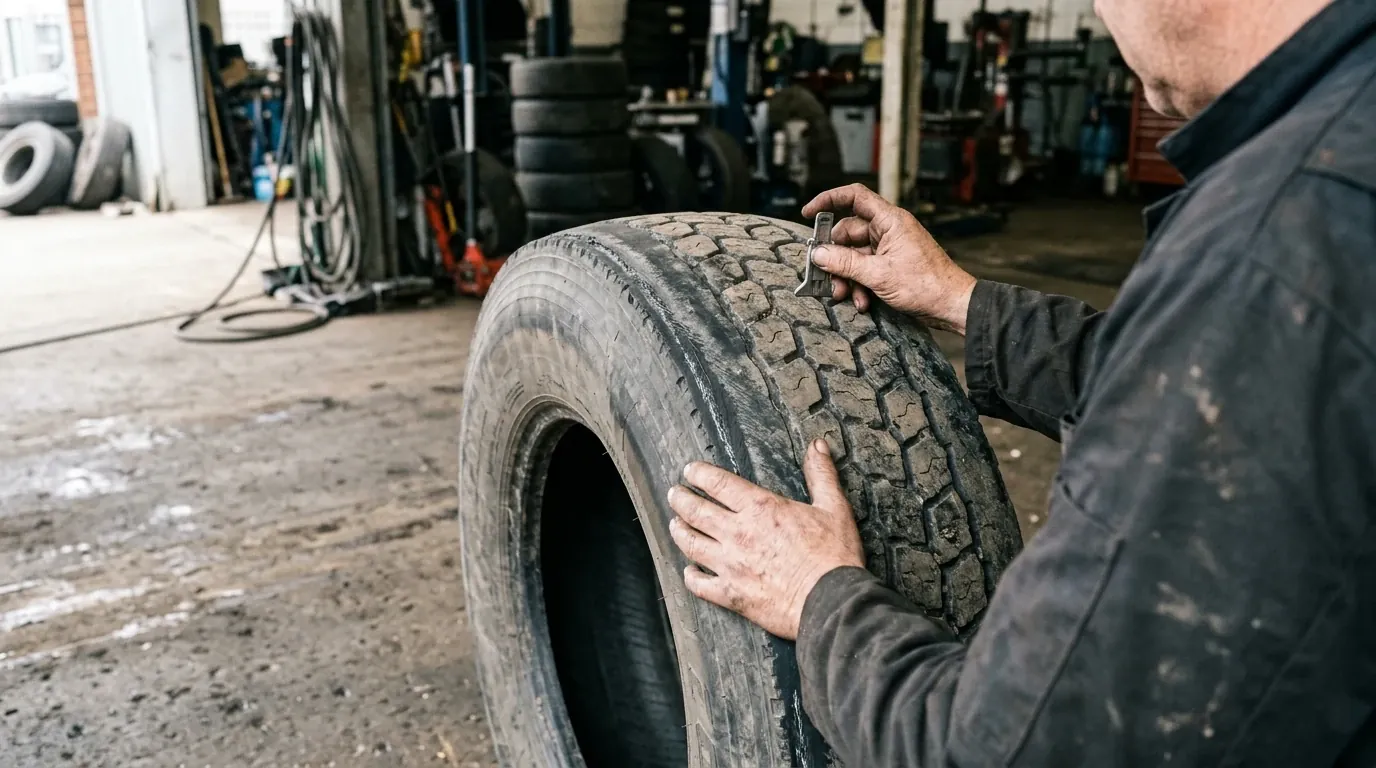
Why do truck tyres wear unevenly?
A tyre tread wears evenly when the whole contact surface carries the same load. When the pressure is wrong, wheel alignment is off, the suspension is damaged or the wheel is unbalanced, the load concentrates in one area and that area wears faster. In many cases the cause lies in the vehicle, not only the tyre.
Short answer: wear on both shoulders means under-inflation, wear in the centre means over-inflation, wear on one side means misaligned wheels (camber, toe), patchy or sawtooth wear means failed shock absorbers or a loose suspension, and cupped wear means an unbalanced wheel. Measure the pressure first, then check the mechanical parts.
Diagnostic table for wear patterns
| Wear pattern | Common causes | What to do |
|---|---|---|
| Wear on both shoulders | Under-inflated tyre, overloading | Inflate to the correct pressure when cold, check the actual load |
| Centre tread wear | Over-inflated tyre | Release air down to the recommended pressure |
| Wear on one side (one shoulder) | Camber or toe off, bent axle, loose ball joint | Check and adjust wheel alignment, repair damaged mechanical parts |
| Patchy wear, sawtooth wear | Failed shock absorbers, loose suspension, toe out of specification | Repair the shock absorbers, tighten or replace loose parts, realign |
| Cupped wear in spots | Unbalanced wheel, shock absorber or suspension problem | Balance the wheel, check the braking system |
| One tyre of a dual pair wears | The two tyres differ in pressure or in diameter | Equalise the pressures, pair tyres with the same level of wear |
Wear on both shoulders and in the centre: pressure faults
These are the two most common wear patterns and the easiest to fix. Under-inflation squeezes the sidewall, so the shoulders carry more load and wear first. Over-inflation bulges the tread, so the centre carries the load and wears first. Reference pressures by size are in the article on truck tyre pressure: for example 12R22.5 and 11.00R20 are both at 930 kPa. Always measure when the tyre is cold, not right after the truck has been driven.
Wear on one side: wheel alignment
If one shoulder is clearly more worn than the other, think of camber (the tilt of the wheel) and toe (how far the wheels point in or out). Wrong toe also causes feather wear: the tread blocks are smooth in one direction and feel sharp on one side when you run a hand over them. After a collision, hitting a large pothole or replacing steering parts, check the wheel alignment.
Patchy and cupped wear: shock absorbers and balance
Failed shock absorbers make the wheel bounce and touch the road intermittently, producing scattered worn patches or a sawtooth pattern. An unbalanced wheel produces cupped spots at even intervals around the circumference, usually with steering wheel vibration in a certain speed range. Deal with the mechanical cause first; if you only replace the tyre, the wear pattern will come back.
How to measure and check tyre wear
- Measure the pressure when cold with an accurate gauge and compare it with the recommended level for the tyre size and the vehicle's load.
- Measure the tread depth at several points on the same tyre: inner shoulder, centre, outer shoulder. The difference between points shows the wear pattern.
- Compare with the original tread depth in the catalogue, for example 15.5 mm for many TBR tread patterns, 12.5 mm for 6.50R16 and 7.50R16.
- Run a hand over the tread in both directions to detect feather wear.
- Look at the sidewall and tread for cuts, bulges and cracks at the base of the tread blocks.
The minimum tread depth must follow current regulations; do not wait until it is close to the minimum before replacing, because a heavily worn tyre grips poorly in the rain.
Tyre rotation and alignment: when to do it?
- Regular rotation: swap tyre positions between axles as the vehicle manufacturer instructs to share the load evenly, especially since drive axle tyres wear faster than steer axle tyres.
- Wheel alignment: when you see uneven wear, the vehicle pulls to one side, after a collision, or after repairing the suspension or steering.
- Wheel balancing: when the steering wheel vibrates or the tyre has cupped spots.
- Pressure checks: at least as scheduled in the fleet's maintenance plan and before a long trip.
When should you replace a tyre?
Replace the tyre when the tread reaches the minimum depth under current regulations, when the sidewall bulges, has a deep cut or exposes the ply, or when the wear difference is too large to fix by rotation. If the casing is still sound, consider retreading; see the article on when to retread a tyre. For cost per distance, read tyre cost per km.
Choose the right tyre specification to limit uneven wear
Choosing a tyre with a load index sufficient for the load per wheel keeps the tyre from being overloaded and wearing at the shoulders. See choosing tyres by load, use the tyre calculator and browse the TBR truck tyres range. The technical tables on the technical page also have a section on tyre wear.
Send a quotation request
The website only presents products and receives quotation requests; it does not sell online. State clearly the vehicle type, the tyre specification in use, the axle position with the unevenly worn tyre and the usual load, then send it through the contact page for advice and a quotation.
Frequently asked questions
- What causes wear on both shoulders of a truck tyre?
- Usually under-inflation or overloading. Re-measure the pressure when cold and check the actual load.
- What causes wear in the centre of the tread?
- Usually over-inflation. Release air down to the recommended pressure for the tyre size and the vehicle's load.
- Does a tyre worn on one side need alignment?
- Yes. Wear on one shoulder is usually caused by wrong camber or toe; check and adjust the wheel alignment, and also see whether the axle and ball joints are loose.
- How often should truck tyres be rotated?
- Follow the vehicle manufacturer's maintenance schedule and the actual wear condition; check wear regularly to decide.
- Does uneven wear affect safety?
- Yes. A tyre with uneven wear has poorer grip, runs hotter and is more likely to fail in the heavily worn tread area, especially in the rain.
Need a tyre quotation?
Send your sizes and quantities and our sales team replies with a project quotation within 24 working hours.
Sizes that match this guide
Add them straight to the quotation request and send once.