

What is a load index?
The load index (LI) is a code number corresponding to the maximum load each tyre can carry at the specified pressure. For example, LI 152 corresponds to 3,550 kg and LI 149 to 3,250 kg. In the marking 152/149, the first figure is the load in single fitment and the second is the load in dual fitment.
Short answer: load per wheel = axle load ÷ number of wheels on the axle. Select a tyre whose load index is greater than or equal to the load per wheel; in dual fitment use the second figure.
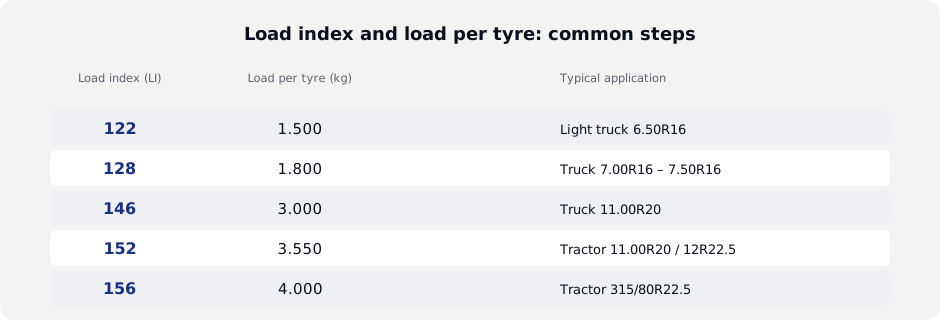
Common load index table
| Load index (LI) | Max load per tyre (kg) | Load index (LI) | Max load per tyre (kg) |
|---|---|---|---|
| 120 | 1,400 | 142 | 2,650 |
| 122 | 1,500 | 144 | 2,800 |
| 124 | 1,600 | 146 | 3,000 |
| 126 | 1,700 | 148 | 3,150 |
| 128 | 1,800 | 149 | 3,250 |
| 130 | 1,900 | 150 | 3,350 |
| 132 | 2,000 | 152 | 3,550 |
| 134 | 2,120 | 154 | 3,750 |
| 136 | 2,240 | 156 | 4,000 |
| 138 | 2,360 | 160 | 4,500 |
| 140 | 2,500 | 164 | 5,000 |
How to calculate load per wheel
The most important step is determining the actual load on each wheel, not the vehicle's rated load. Load is distributed unevenly between axles and can deviate considerably when the vehicle is fully laden.
- Determine the axle load: use actual weighbridge data if available, or the maximum axle load stated in the inspection certificate.
- Count the wheels on the axle: a single axle has 2 wheels, a tandem axle has 4, a tri-axle has 6 (depending on configuration).
- Divide the axle load by the number of wheels: the result is the load each wheel must carry.
- Add a safety margin: in practice, choose a tyre whose load index is at least one step above the calculated load.
- Cross-check against the load table for the size: maximum load also depends on inflation pressure, not only on the load index.
| Axle | Axle load | No. of wheels | Load per wheel | Minimum load index |
|---|---|---|---|---|
| Steer axle | 7,000 kg | 2 | 3,500 kg | 152 |
| Drive axle (dual) | 18,000 kg | 4 | 4,500 kg | 157 |
| Trailer axle (dual) | 18,000 kg | 4 | 4,500 kg | 157 |
How do single and dual fitment differ?
- Single fitment: one tyre per side of the axle; use the first load index (for example 152).
- Dual fitment: two tyres side by side on each side; use the second load index (for example 149), because the two tyres share the load and run hotter.
- Do not fit tyres with different load indices in the same dual pair: the load imbalance overloads the weaker tyre.
- Keep the specified spacing between the two dual tyres: to prevent rubbing and heat build-up.
Is choosing excess load capacity better?
Fitting a tyre with a load index far above requirement generally makes the tyre stiffer, reduces ride comfort and adds cost without a corresponding gain in service life. The correct approach is to select adequate capacity with a sensible safety margin, and to maintain the correct pressure per the load table.
Quick calculation tool
To quickly calculate load per wheel and see suggested suitable sizes, use the tyre selector by load. The tool takes axle load, number of wheels per axle and road conditions, then returns the sizes that meet them.
Frequently asked questions
- What does load index 152/149 mean?
- Each tyre carries 3,550 kg in single fitment and 3,250 kg in dual fitment, at the pressure specified in the load table.
- How do I know whether the current tyres have sufficient load capacity?
- Compare the load index on the sidewall with the load per wheel calculated from the actual axle load.
- Is a tyre with a higher load index safer?
- Safer in terms of load, but not always better overall: the tyre is stiffer, ride comfort decreases and cost rises.
- Where do I get the axle load?
- From the vehicle inspection certificate or from actual weighbridge data with a full load.
Need a tyre quotation?
Send your sizes and quantities and our sales team replies with a project quotation within 24 working hours.
Sizes that match this guide
Add them straight to the quotation request and send once.